
Oat Market Update
- Monday November 10, 2008
This analysis featured in the November 10, 2008 issue of the HGCA's MI Prospects, Volume 11, Issue 10
Key Points
Oat production both in the UK and Europe has increased this year. The market appears to be relatively well balanced in the UK with the expectation that there will be further increases in milling demand for domestic oats. European prospects are less favourable as increased oat supplies compete in non-traditional feed markets.
UK Situation
In 2007/08 UK oat supply and demand appeared to be relatively well balanced. There was a small positive trade balance and a small increase in closing commercial stocks (Table 1). Early in 2007 high prices for oats relative to other cereals might have encouraged an expansion in sown area. This was not immediately evident as spring oats are now a relatively small and declining portion of total planting. The following autumn, winter oat sowings increased by 22%, which more than offset reduced spring plantings this year. The total area of oats was 129,000ha, a 7% increase over the previous year.
continue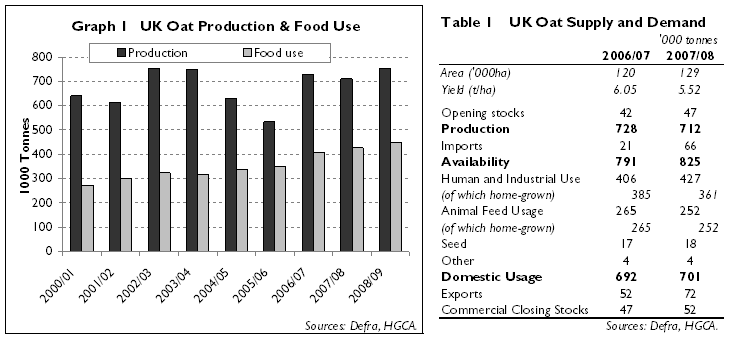
As with almost all 2007 European cereals, oat yields were disappointing and domestic supplies were lower as a result. Evident from the increase in imports, the UK crop did not meet end-user milling quality requirements. But with EU feed grains generally in short supply, UK oat exports also increased, exceeding imports by a small margin for the year as a whole. Domestic milling use continued to rise and at 0.427Mt is almost double what it was a dozen years ago (Graph 1, see above). Other use, mainly feed, appears to be relatively stable at about 0.25Mt.
In the context of other cereal, oat prices were perhaps disappointing although they were well above prices seen since the mid-1990's, the brief peak on the winter of 2007 aside. By the time autumn planting decisions were made, prices of all cereals had risen to incentive levels. But the high prices in the winter of 2007 may have helped to hold oat area in a very competitive environment. The winter oat area for harvest 2008 was up another 11% and offset a further decline in spring oats. Total sowings were 0.131Mha, 2% above the previous year and the largest area since 1985.
Expectations before harvest 2008 were for exceptionally good yields of very high quality oats. And, indeed, early harvested crops appear to have met these expectations. But the crop was relatively late maturing and ran into the weather challenges in late August and early September. This was particularly evident in the West and North where a significant portion of the crop is grown. Further, conflict with the winter wheat harvest was greater than usual.
DEFRA provisionally estimates a 0.752Mt crop, up 6% from 2007, the largest crop since 2002. Yields are only marginally higher than last year’s relatively poor results, except in the Eastern regions, which are less important production areas than they are for other cereals. Although Defra cautioned that the estimate was based on partial survey returns as the actual survey had been delayed for three weeks because of the late harvest, there is some expectation that the crop is of this size. Quality was downgraded by the weather but there is some confidence that, in contrast to last year, millers will be able to source their needs from the domestic crop. With exceptions, evident discolouring is limited to hulls, with relatively bold groats being usable by millers.
Total domestic supplies in 2008/09 are seen slightly (1%) above last season's 0.791Mt. This may not seem an overly onerous increase with milling consumption typically increasing by about 25,000t per year in recent years and over 70,000t exported last year. A caution is, however, necessary. If milling consumption of domestic oats falters, either because of quality factors or general economic conditions resulting in reduced demand for oat products, market conditions for oat exports to Europe will be much more challenging than last year.
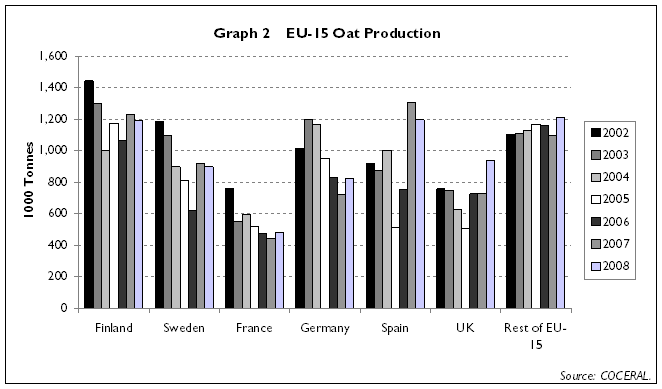
Normally UK winter oats find ready markets off the combine before new crop spring sown oats are widely available on the Continent. This year August UK oat exports were limited to 8,600t, more than 40% below last year and the lowest August exports since 1999. While the lateness of the harvest was a factor, trade on the Continent has been slow this year. Some old crop supplies were still in the system and with grain prices falling on greatly improved cereal crops and supplies, buyers may have been holding back. For the EU-27 production is estimated by COCERAL at 9.1Mt, up 3%, from a 1% increase in area. More critically, EU-15 production which accounts for much of the trade was up 5% at 6.7Mt and the largest crop since 2003 (Graph 2).
This is the second successive year that oats output has increased. However, while last year’s extra oats found ready markets due to short European feed grain supplies, this will not be the case this year. In 2003 restitution was provided for the export of almost 0.45Mt of Scandinavian oats to balance supply and demand. While milling use of oats has increased quite significantly over the last five years, there may be 0.2 to 0.3Mt of oats competing for non-traditional feed grain use in crowded markets. Ultimately the direction of the European market will be determined by whether the Scandinavian oat export restitutions are granted.
This special export restitution provision was set up for Finnish and Swedish oats when these two countries joined the EU in 1995. It was recognised that such was necessary if Sweden and Finland were to continue to supply their south east US seaboard market. It was in reality an alternative to the EU establishing such CAP provisions as market invention for oats. Whether the EU Commission is in a position to grant these special export restitutions when market prices are above intervention support is debatable. What is evident is that the collapse of the ocean freight markets reduces the level of restitutions needed to export grain and budget is almost certainly available.
At this time it seems most likely that oats production will decline in 2009. For the UK a very late harvest and wet field conditions this autumn have almost certainly resulted in a reduced area of winter oats and recent experience suggests that there will be little interest in increasing spring oat area. Thus there is unlikely to be a push to clear 2008/09 oat supplies at all costs as any decline in 2009 oat sowing is likely to result in relatively tight supply situation for 2009/10.
David Walker (001) 780 434 7615
European Markets
Market Prospects
top of page
This site is maintained by: David Walker
.
Copyright © 2008 Copyright &
Disclaimer Information.
Last Revised/Reviewed 081113